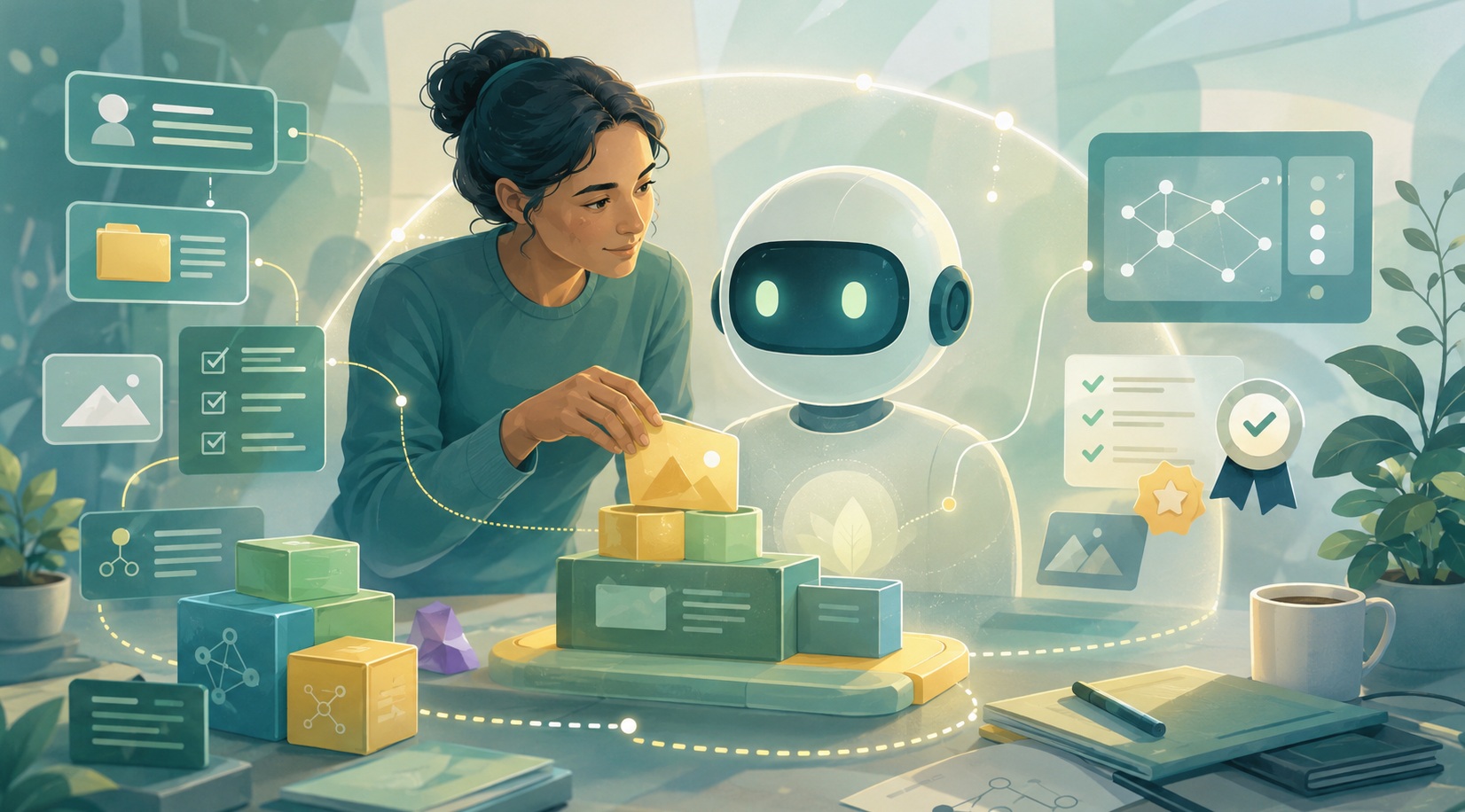
What migrating corporate learning from an LMS to SharePoint taught me about context, curation, and learning in the flow of work
For a long time, corporate learning has followed a familiar script.
A new topic appears. Someone decides that people need to learn it. A course is created, a video is uploaded, a deck is attached, and a multiple-choice quiz is placed at the end. Once everything is ready, the message goes out: new course launched, go watch the video, complete the assessment, and mark it as done.
There is nothing inherently wrong with that model. In many cases, it still makes sense. A traditional LMS gives organizations a way to organize, track, and deliver learning at scale. It is especially useful when the goal is compliance, certification, formal progression, or structured reporting. The problem is not that courses are useless, or that videos are outdated, or that assessments have no value.
The problem is that, too often, corporate learning asks people to leave the flow of work in order to learn something that is supposed to help them work better.
That creates a quiet contradiction. We say learning should be relevant, practical, and connected to performance, but then we often place it in a separate environment, with a separate logic, separate navigation, separate deadlines, and separate expectations. The learner has to stop what they are doing, go somewhere else, consume the content, complete the activity, and then return to work hoping that the knowledge will transfer.
Sometimes it does. Many times, it does not.
In a world where people are already surrounded by messages, meetings, dashboards, documents, platforms, processes, and constant change, learning that feels like extra work will always struggle to compete with the work itself. This is not because people do not care about learning. It is because attention is limited, time is fragmented, and the value of a learning experience is often judged by a very simple question: how does this help me right now?
That question has been on my mind while migrating corporate L&D content from a traditional LMS into SharePoint.
At first, the work looked like a platform migration. Move content from one place to another. Rebuild pages. Organize resources. Improve access. Make things easier to find. But the deeper I went into the process, the more I realized that the real shift was not technical. It was conceptual.
This was not just a migration from an LMS to SharePoint. It was a shift from course delivery to knowledge access.
It was a shift from learning as a destination to learning as part of the work ecosystem.
And once learning moves closer to the work ecosystem, the role of AI changes too.
Because if learners are going to use AI inside their daily workflows, then L&D cannot focus only on teaching people how to prompt. We also need to think about what the AI is connected to, what context it sees, what language it uses, what knowledge it trusts, and how it supports people when they need help.
In other words, AI needs teachers too.
From “go take the course” to “ask when you need it”
The old learning model sounds something like this: new course launched, go watch the video, read the deck, and complete the MCQ.
The emerging model sounds different: new knowledge is available, it is already part of the ecosystem, the agent has ingested it, go ask your questions when you need them.
That sentence represents a much bigger change than it may seem at first. It does not mean that traditional learning materials disappear. It does not mean we stop creating videos, articles, guides, checklists, job aids, decks, examples, or assessments. Actually, those materials may become even more important, but their role changes.
A video is no longer just a video. It can also become a transcript, a searchable explanation, a source for an AI agent, a set of examples, a glossary, a FAQ, a scenario, or a decision aid. A course is no longer only a container for content. It can become part of a structured knowledge base. A learning path is no longer just a sequence of modules. It can become a map of concepts, tools, behaviors, questions, and moments of need.
This is where SharePoint becomes interesting to me, not because SharePoint is magical, but because it lives much closer to the place where work already happens. People already move through Microsoft 365. They use Teams, documents, pages, lists, forms, search, shared spaces, and automations. They are already inside that ecosystem every day.
So the question becomes simple: why should learning live somewhere else?
If learners need support, they should be able to ask questions in their own language, at the moment they need help, inside the same curated ecosystem they already navigate. They should not always need to know the name of the course, the exact title of the module, the location of the video, or the folder where someone uploaded a deck six months ago.
They should be able to ask, “How do I apply this to my current task?” or “What does this concept mean in simple terms?” or “Where do I start if I am new to this process?” or “Can you show me an example based on my role?”
That is more than content access. That is learning in the flow of work.
The agent is only as smart as the ecosystem
But there is a catch.
If we want learners to ask better questions inside the work ecosystem, the AI agent needs better context. And that context does not appear by magic.
This is where many AI implementations fall into a familiar trap. We imagine that we can connect an AI tool to a repository and it will suddenly understand the organization. Point it at SharePoint, let it read everything, and wait for the intelligence to emerge.
But that is not intelligence. That is exposure.
And exposure to messy knowledge can create messy answers.
If a repository contains outdated documents, duplicated pages, conflicting versions, unclear ownership, ambiguous language, disconnected files, and old materials nobody uses anymore, the AI will not automatically know what matters. It will not magically understand which source is authoritative, which document is current, which terminology reflects the strategy, or which explanation is no longer valid.
It will see the mess, and then, with impressive confidence, it may reproduce the mess.
This is one of the reasons I believe AI needs teachers too. They need curated knowledge, clear boundaries, updated sources, instructional intent, human feedback, SME validation, testing, and maintenance. They need someone to ask what the agent should know, what it should ignore, what it should never answer with confidence, which sources it should prioritize, and when it should redirect the learner to a human.
That work is not just technical. It is deeply connected to learning design.
Or, more accurately, it is connected to learning systems design.
When content becomes infrastructure
When learning content lives only inside a course, its main audience is the human learner. The goal is to present information clearly enough for someone to consume it, understand it, and hopefully apply it later.
But when that same content becomes part of a knowledge ecosystem, it has at least two audiences. It still needs to serve the human learner, but it also needs to serve the AI system that may retrieve it, explain it, summarize it, connect it with other ideas, or use it to answer a question at the moment of need.
That changes how we design.
A long video with no transcript may work as a passive learning object, but it is weak as part of an AI-ready knowledge system. A beautiful slide deck with vague titles and little explanation may work during a live session, but it may not be enough for an agent that needs to answer specific questions later. A policy document may be complete from a legal or procedural perspective, but if it is dense, full of exceptions, and disconnected from practical examples, it may be hard for both humans and AI to use well.
This does not mean everything needs to be simplified until it loses depth. It means content needs to become more structured, searchable, contextual, and usable. It needs better headings, better summaries, better examples, better metadata, better version control, better ownership, and better connections between concepts.
In a traditional LMS, content can survive as a static object. In a knowledge ecosystem, content behaves more like infrastructure. It supports people, agents, search, onboarding, performance, reporting, and future updates.
That requires a different design mindset.
We are not only asking, “Is this course clear?” We are also asking, “Can this knowledge be found, trusted, questioned, reused, updated, and applied?”
Mini Brains as small learning architectures
This is why I keep coming back to the idea of Mini Brains.
For me, Mini Brains are not just better prompts. They are small, portable learning architectures for AI behavior. A loose prompt says, “Help me with this task.” A Mini Brain says, “Here is who you are, what you are allowed to do, what knowledge you should use, what boundaries you must respect, what process you should follow, and where the human stays in control.”
That difference matters because when we place AI inside learning ecosystems, we are not simply asking it to generate content. We are asking it to participate in a knowledge relationship with the learner.
That relationship needs design.
An agent that supports onboarding should not behave the same way as an agent that supports compliance. An agent that helps with strategic frameworks should not behave the same way as an agent that helps rewrite a paragraph. An agent that supports a learner should not simply give answers. It should help the learner understand, question, verify, and apply.
This is where the distinction between offloading and scaffolding becomes essential.
Bad AI use can turn into offloading, where the learner gives away the thinking and receives a finished answer. Good AI use can become scaffolding, where the learner receives support that helps them think better, ask better questions, and act with more confidence.
The goal is not to build agents that learn for people.
The goal is to build agents that help people keep learning.
That difference is everything.
The new role of L&D
This shift changes the role of L&D in a very practical way.
In the old model, L&D was often treated as a content production function. A stakeholder requested a topic, a learning team created a course, the course was published, completion was tracked, and the work was considered done.
But in a knowledge ecosystem, publishing is not the end of the work. It is the beginning of a living system.
The content needs to stay updated. The agent needs to stay aligned. The learner questions reveal gaps. Search behavior reveals confusion. Feedback reveals missing examples. Business priorities change, so the knowledge base needs to change too.
This means L&D becomes less like a factory and more like a learning infrastructure team.
We are not only creating learning objects. We are designing the conditions where people, knowledge, and AI systems can work together responsibly. That includes curating content, structuring knowledge, designing pathways, creating AI-ready resources, building agents and Mini Brains, defining boundaries, collaborating with SMEs, testing outputs, maintaining alignment, and helping learners use AI without surrendering their judgment.
This is where I see the role evolving from Learning Experience Designer to Learning Systems Designer.
The experience still matters. In fact, it matters more than ever. But the experience is no longer limited to a course page, a video, or an assessment. The experience now includes the ecosystem around the learner.
Can they find what they need? Can they ask in their own words? Can they trust the answer? Can they see where the information came from? Can they keep thinking instead of simply accepting an output? Can they apply the knowledge in the real context of their work?
Those are learning design questions.
They are also system design questions.
Learning where the work happens
The promise of AI in L&D is not that we can generate more courses faster. That may be useful sometimes, but it is not the real transformation.
The real transformation is that learning can become more situated, responsive, and integrated. Instead of asking people to leave their work to consume content, we can bring structured support into the environment where the work already happens. Instead of treating AI as a shortcut machine, we can treat it as a contextual learning interface. Instead of building isolated courses, we can build knowledge systems that help people and agents learn from the same curated foundation.
This is not about replacing traditional materials. It is about giving them a new role.
A course can still exist. A video can still exist. A guide can still exist. An assessment can still exist. But they should not sit alone, disconnected from the daily reality of work. They should become part of a broader system where knowledge is easier to find, easier to question, easier to apply, and easier to maintain.
That is the opportunity I see in moving learning into SharePoint and similar work ecosystems. It is not just a better place to store content. It is a better way to make content alive.
Teaching the systems that support humans
The more we bring AI into learning, the more we need to stop treating it as magic.
An AI agent does not automatically know what matters. It does not automatically understand the organization. It does not automatically respect the learning strategy. It does not automatically know which document is current, which framework is preferred, which example is appropriate, or which answer could create confusion.
It needs to be taught.
Not once, but continuously.
And that teaching is not only technical. It is pedagogical, strategic, and human. We need to teach agents with curated context, clear instructions, well-structured knowledge, feedback loops, and human judgment.
The future of L&D is not only teaching people how to use AI. It is also teaching AI how to support people inside the real context of their work.
That may be one of the most important shifts ahead.
Because if AI is going to become part of the learning ecosystem, then L&D has a responsibility to shape that ecosystem with intention. Not by chasing every new tool, not by replacing every course with a chatbot, and not by pretending that automation equals learning, but by asking better questions.
What knowledge should this system trust? How should this agent support the learner? Where should the human remain in control? What kind of thinking are we trying to strengthen? How do we make learning easier to access without making thinking easier to avoid?
That last question matters the most to me.
Because the goal is not to remove the learner from the process. The goal is to create better conditions for learning, reflection, decision-making, and growth.
A good learning ecosystem does not simply answer faster.
It helps people understand better.
And if we want AI agents to become part of that ecosystem, then yes:
AI needs teachers too.