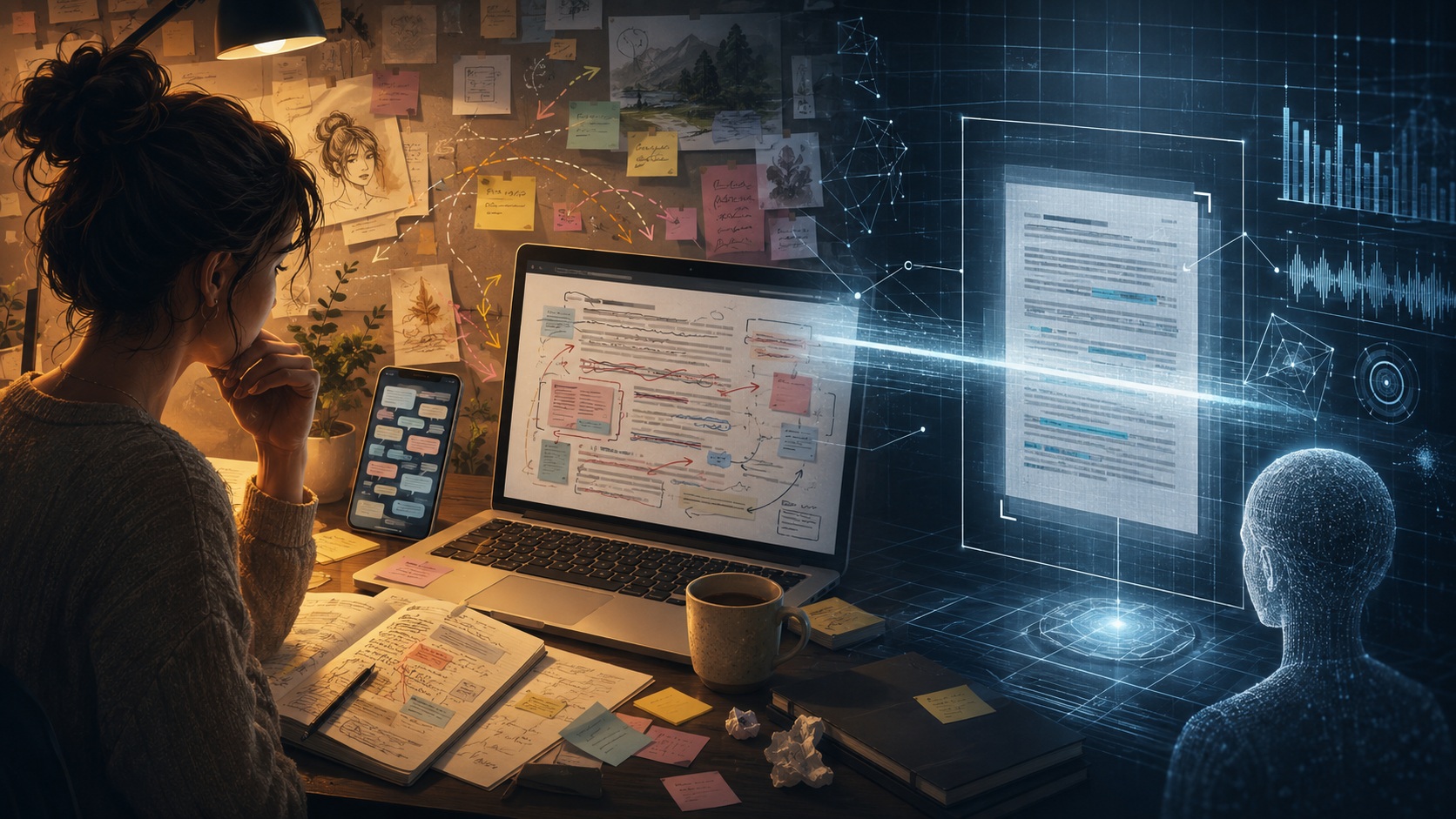
What the panic around AI detection gets wrong about authorship, education, and human judgment
I have a problem with AI detectors.
Not because I think people should use AI irresponsibly. Not because I think authorship does not matter. Not because I believe students, writers, researchers, or professionals should submit work they do not understand.
Actually, it is the opposite.
I care a lot about authorship.
I care about thinking.
I care about learning.
I care about responsibility.
That is exactly why I think AI detectors are the wrong tool for the job.
They pretend to solve a real problem, but they often create a worse one. They promise certainty where there is only probability. They turn writing into evidence of suspicion. They invite institutions, clients, and educators to outsource judgment to a scanner.
And in the process, they punish some of the people we should be encouraging the most: people who write clearly, people who revise carefully, people who read a lot, people who have developed a strong voice, and people who learned to write in more than one language.
That irony is hard to ignore.
For years, education told us to write better.
Be clearer. Structure your ideas. Avoid unnecessary repetition. Use precise language. Improve your grammar. Build arguments. Edit your work. Sound professional.
Now some of those same qualities can make a text look suspicious.
So what are we teaching people now?
Write worse so you look human?
Add mistakes so you look authentic?
Lower your standards so a machine does not accuse you of using another machine?
That is not academic integrity.
That is algorithmic insecurity.
The detector does not see the process
My writing process does not look clean from the inside.
It usually starts with short notes. Sometimes they are one-liners. Sometimes they are just a few words. Sometimes they are in English. Sometimes they are in Spanish. Sometimes they are in some strange Spanglish middle ground because one language came faster, or because the word I needed was shorter, sharper, or closer to the feeling I was trying to catch.
Most of the time, the idea arrives before I am ready for it.
So I open WhatsApp and send myself a message.
Fast.
Because if I do not write it down, it is gone.
One idea after another. Dozens of them. Sometimes in the middle of the night. Sometimes in the middle of a work video call because someone says something, or something on screen triggers a thought I cannot afford to lose.
The thought branches.
If I wait for the “right time” to write it properly, the idea disappears.
Later, those fragments move into a Word document.
That is where the real work starts.
I begin cleaning. Organizing. Grouping. Moving things around. Trying to find some kind of order inside the mess. Then I expand those single thoughts. I combine them. I rewrite them. I delete parts that felt clever but empty. I check what is missing. I check the rhythm. I check the flavor.
Then I start fighting with the wiggly snakes.
Those blue underlines in Word telling me something is wrong.
That I misspelled something.
That my grammar is not quite right.
That my structure is odd.
That a sentence is too informal, too long, too regional, too much like me.
And I look at them and think: Give me a break.
My head goes faster than my mouth, and even faster than my hands.
Also, I am Rioplatense. We do not always use “proper” Spanish. Sometimes we do not use “proper” English either. Sometimes the sentence is technically imperfect, but it carries the exact rhythm I need.
Sometimes the “mistake” is the voice.
So no, writing is not a clean sequence of perfect paragraphs appearing one after another.
Writing is messy.
It is interrupted. It is emotional. It is obsessive. It is insecure. It is full of abandoned drafts, sudden connections, strange notes, half–ideas, overcorrections, revisions, and moments where I almost delete everything because I do not like what I see.
Sometimes one article becomes three because the idea branches too much.
Sometimes I write several articles at the same time because my head refuses to stay in one lane.
Sometimes I abandon a draft because I am not ready for it, or because I do not trust it yet.
And yes, I use AI in that process.
Not to replace my thinking.
To pressure-test it.
I use AI to ask whether I am repeating myself. To check if something is unclear. To see if I missed a social cue, because I know I can sound aggressive on the page. My filter is not always great when an idea has teeth.
So I ask for feedback.
I look at the suggestions.
Then I use my own taste again.
Sometimes I accept something.
Many times I reject it.
Because the point is not whether AI touched the process.
The point is whether I still own the work.
And that is exactly what AI detectors cannot see.
They do not see the WhatsApp notes. They do not see the midnight idea. They do not see the messy draft. They do not see the Spanglish. They do not see the deleted paragraphs. They do not see the insecurity. They do not see the Word document slowly becoming something readable.
They only see the final text.
And from that final text, they pretend they can judge the process.
That is the problem.
AI detectors do not detect authorship
AI detectors do not know whether you wrote something.
They do not see your notes. They do not see your drafts. They do not see your references. They do not see the argument developing over time. They do not see the idea that came from a class, a book, a video call, a walk, a frustration, or a random thought you sent yourself before it disappeared.
They only see the polished artifact.
Then they try to guess whether it looks statistically human or statistically artificial.
That distinction matters.
A detector is not reading like a teacher.
It is not reading like an editor.
It is not reading like a colleague who understands your field, your background, your humor, your references, your rhythm, or your intention.
It is measuring patterns.
Predictability. Sentence variation. Word choice. Structural consistency. Smoothness. Rhythm.
In simple terms, it asks: does this writing look too clean, too polished, too predictable, too organized?
But good writing is often clean, polished, predictable, and organized.
A strong academic writer may sound structured. A professional writer may sound concise. A researcher may use precise terminology. A non-native English speaker may use more standard phrasing because they are trying to be clear. A person who reads a lot may naturally produce prose that feels fluent and controlled.
That does not make them artificial.
It makes them skilled.
The strange pressure to sound worse
This is the part that bothers me the most.
AI detectors are not just misjudging texts. They are starting to shape how people write.
Writers are being encouraged, directly or indirectly, to make their writing messier so they can pass as human. Students are told not to sound too polished. Professionals are told to “humanize” their work. Researchers are forced to defend writing that is clear precisely because they worked hard on it.
And then, very conveniently, some of the same platforms that flag your writing as AI-generated offer a premium feature to make it sound more human.
That business model feels deeply wrong.
First, the tool creates anxiety.
Then it sells relief.
It tells you your voice is suspicious, then offers to rewrite it for a fee.
That is not writing support.
That is voice laundering.
The result is a very strange cultural message: do not write like yourself. Write like whatever the detector thinks a human should sound like.
But who decided that?
Apparently, “human” now means uneven, informal, slightly chaotic, and imperfect enough to look statistically safe.
That may work for some people.
It does not work for everyone.
Some people write with structure because they were trained to. Some people write carefully because English is not their first language. Some people write with precision because their field requires it. Some people write with rhythm because they have read thousands of pages and absorbed patterns over time.
And some people write in fragments first, mix languages, fight grammar tools, rewrite the same paragraph five times, ask AI for feedback, reject most of it, and still end up with a polished piece that came from a very human mess.
Language is not a compliance form.
It has accent, region, personality, memory, rhythm, and identity. It carries where we come from. It carries what we have read. It carries how we think.
When detectors punish that complexity, they are not protecting writing.
They are flattening it.
AI detection is a trust problem disguised as a technology problem
The deeper issue is not really AI detection.
The deeper issue is trust.
Educators do not trust students. Clients do not trust freelancers. Managers do not trust employees. Institutions do not trust their own assessment designs. Publishers do not trust writers.
And instead of doing the hard work of rebuilding trust, everyone wants a quick scanner that says guilty or not guilty.
That is the fantasy.
Paste the text. Get a percentage. Make a decision.
But authorship does not work like that.
Learning does not work like that.
Writing does not work like that.
A percentage score cannot tell you whether a student understands the argument. It cannot tell you whether a writer developed the idea. It cannot tell you whether a researcher used AI responsibly as a thinking partner, irresponsibly as a shortcut, or not at all.
It cannot tell you whether the work reflects real understanding.
It can only tell you that the final text resembles patterns the tool associates with AI-generated writing.
That may be useful as a weak signal.
It should never be treated as a verdict.
If an educator takes an AI detector score and treats it as proof, that is not technological sophistication. That is a failure of professional judgment.
I know that sounds harsh.
But I think we need to be honest here.
If an academic integrity process depends on a tool that cannot see the process, cannot understand the learner, cannot verify authorship, and cannot explain intent, then it is not defending education.
It is outsourcing education.
And if the whole reaction to AI is simply “AI bad, therefore scanner good,” then we are not engaging with the real challenge.
We are avoiding it.
The real question is not “Was AI used?”
The question “Was AI used?” becomes less useful every year.
AI is already inside the writing process in obvious and invisible ways. It may appear through ChatGPT, Claude, Gemini, Copilot, Grammarly, Word suggestions, translation tools, search engines, autocomplete, transcription, summarization, brainstorming, or editing support.
So where exactly do we draw the line?
If I use AI to brainstorm a title, did AI write the article?
If I use Grammarly to clean up a sentence, is the sentence mine?
If Word suggests a structure and I reject it, does that count?
If I translate an idea from Spanish to English and then rewrite it completely, who authored the final paragraph?
If I ask AI to challenge my argument and then I write a stronger version myself, is that cheating or learning?
These are not simple questions.
Pretending that a detector can answer them is intellectually lazy.
The better question is not: Was AI involved?
The better question is: Can the person explain, defend, revise, and take responsibility for the work?
That is what matters.
If a student submits an essay, ask them about it. Ask why they chose that argument. Ask them to explain a paragraph. Ask them to connect the idea to another concept from the course. Ask them what they would change after receiving feedback.
If they can do that, there is learning.
If they cannot, there is a problem.
But that problem is not solved by a detector. It is solved by better assessment design, better dialogue, better process evidence, and better human judgment.
We need receipts, not detectors
If institutions really care about authorship, they should stop obsessing over the final text and start paying attention to the process.
A final document is only the last frame of the movie.
The real story is in the drafts, notes, edits, comments, decisions, questions, sources, conversations, and revisions that led there.
That is why version history is more meaningful than an AI score.
A cloud document can show development over time. A portfolio can show progression. A reflection can show metacognition. A short oral defense can show understanding. A live writing task can show ability. A process log can show how the work evolved.
None of these are perfect.
But they are closer to the truth than pretending a detector can read intention from sentence rhythm.
In education, this means redesigning assignments so students have to show their thinking, not just submit a polished artifact.
In professional writing, it means asking for outlines, drafts, rationale, sources, editorial decisions, and revision history.
In business, it means evaluating whether the content is useful, accurate, responsible, and aligned with the goal.
In all cases, it means moving from suspicion to evidence.
That is a much healthier frame.
Taste is still the human detector
In my previous article, I wrote that AI can mimic slop, but it cannot mimic vision.
I keep coming back to that idea because it also applies here.
The problem with a lot of AI-generated text is not that it is grammatically wrong. Usually, it is grammatically fine. Sometimes it is painfully fine.
The problem is that it often feels empty.
It has structure, but no pulse.
It has transitions, but no tension.
It has confidence, but no wound.
It has the shape of an argument, but not the lived pressure that makes an argument worth reading.
That is the thing a detector cannot judge.
A detector may flag a human text because it is polished. It may miss an AI text because someone added randomness, slang, or mistakes.
But a thoughtful reader can often sense when something is missing.
Not always.
Not perfectly.
But better than we admit.
There is a kind of taste involved in reading. Not taste as elitism. Not taste as personal preference. Taste as professional judgment. Taste as the ability to notice when something is bland, generic, hollow, overproduced, underthought, or disconnected from real human intention.
You read a paragraph and something feels off.
It is not wrong, exactly.
It just does not go anywhere.
It says all the expected things in the expected order. It uses the right vocabulary. It has the polished surface. But underneath, there is no friction, no risk, no point of view, no surprise, no sense that a person needed to write it.
That is not always proof of AI.
Humans produce empty writing all the time.
That is the uncomfortable part.
AI did not invent generic writing.
It simply made generic writing easier to produce at scale.
So the real enemy is not AI-generated text.
The real enemy is thoughtless text.
And thoughtless text can come from a machine or a person.
The danger of punishing good writers
There is another consequence we should take seriously.
If people start adapting their writing to avoid being flagged, we are not creating more honest writing.
We are creating more performative writing.
Students will learn how to appear human to a machine.
Writers will learn how to add artificial imperfection.
Professionals will learn how to make strong writing look weaker.
That is absurd.
The goal of education should not be to make students sound less capable. The goal of professional communication should not be to make people less clear. The goal of writing should not be to pass a detector.
The goal should be meaning.
Can you think clearly?
Can you communicate honestly?
Can you support your claims?
Can you revise when challenged?
Can you connect ideas?
Can you bring context, experience, and judgment into the work?
Can you stand behind what you wrote?
That is authorship.
Not a percentage.
What educators should do instead
If educators are worried about AI, they should redesign the learning experience instead of trying to police the final product.
Ask for drafts. Ask for annotations. Ask for reflections. Ask students to explain how they used tools. Ask them to compare their first idea with their final argument. Ask them to defend a paragraph orally. Ask them to critique an AI-generated answer. Ask them to identify what is missing, what is shallow, what is biased, what is unsupported.
That is where learning happens.
Not in pretending AI does not exist.
Not in banning tools students will use in every workplace.
Not in treating every polished sentence as suspicious.
The real skill is not avoiding AI.
The real skill is learning how to work with it without surrendering your judgment.
Students need to learn when AI is useful, when it is dangerous, when it is shallow, when it is hallucinating, when it is flattening complexity, and when their own thinking needs to take over.
That requires more teaching.
Not more scanning.
The future belongs to judgment
AI detectors are attractive because they feel simple.
But simple is not the same as true.
The future of writing, learning, and knowledge work will not be protected by better suspicion.
It will be protected by better judgment.
We need people who can read deeply. People who can ask better questions. People who can recognize weak thinking even when it is beautifully formatted. People who can use AI without hiding behind it. People who can explain their work. People who can build process evidence. People who can defend their ideas.
And yes, people with taste.
Because taste is one of the few things that still forces us to stay human in the loop.
Taste says: this is polished, but empty.
Taste says: this sounds correct, but something is missing.
Taste says: this is fluent, but it has no point of view.
Taste says: this may pass the scanner, but it does not deserve the reader.
That is the standard I care about.
Not whether a detector thinks a paragraph is human.
Whether the writing carries intention, clarity, responsibility, and vision.
AI can mimic style. It can mimic structure. It can mimic professionalism. It can even mimic human slop.
But it still cannot own the work.
We do.
And if we want to protect writing, we should stop asking machines to police our voice.
We should ask better from humans.