There is a phrase from El Eternauta that has been stuck in my head lately:
“Lo viejo funciona.“
The old stuff works.
Maybe it is because the past week has been miserable: cold, foggy, and rainy. The kind of weather that makes you want to surrender completely, curl up on the couch, binge some TV, and read some comic books.
I am not thinking about it in a post-apocalyptic way. I am not imagining people rebuilding society with radios, handwritten maps, improvised tools, and whatever still functions after everything else has collapsed.
I am thinking about it in a much more ordinary, professional, and uncomfortable way.
Because in 2026, we are surrounded by some of the most powerful tools we have ever had, and somehow, a lot of work is becoming messier, more expensive, and harder to control.
Not because the technology is bad.
Because we keep reaching for the most futuristic option, even when the problem does not need it.
Right now, there is a strong temptation to make everything agentic. Every process needs an agent. Every task needs automation. Every workflow needs to run by itself. Every small friction point becomes an excuse to build a complex system around it.
And sometimes that makes sense. There are real cases where automation saves time, reduces errors, and creates a better experience.
But sometimes, it is just automation for the sake of automation.
Sometimes a company spends more money on tokens than the task was worth. Sometimes a team spends three days automating a one-time process that could have been done manually in two hours. Sometimes people build workflows so complicated that nobody can explain where the result came from, why a decision was made, or how to fix the system when something goes wrong.
That is not innovation.
That is overengineering with better branding.
And maybe we need to recover a very simple idea: the best tool is not always the most advanced one.
Old systems had one beautiful limitation
Before generative AI became the center of every conversation, many of us worked with more traditional systems.
I started with traditional chatbots, Dialogflow, rule-based flows, decision trees, intents, keywords, scripted responses, fallback messages, and carefully structured paths.
It was not glamorous. It was a lot of work. You had to define what the system could understand. You had to feed it keywords. You had to write variations. You had to anticipate user behavior. You had to build flows, test edge cases, and adjust the structure again and again.
But there was something beautiful about those systems.
When they did not know something, they usually did not pretend.
They did not hallucinate an answer. They did not invent a policy. They did not creatively reinterpret the user’s request. They did not generate five confident paragraphs based on a misunderstanding.
They failed in a more honest way.
They said something like: “I did not understand that.”
Or they escalated to a human.
That limitation was not only a weakness. In many contexts, it was a safety feature.
Today, we often treat that kind of rigidity as outdated. And yes, in many cases, it was frustrating. Rule-based systems could be brittle. They could fail when users phrased things differently. They could require constant maintenance.
But they also forced us to do something important before the system ever interacted with a user: design the boundaries.
We had to decide what the system could answer, what it could not answer, what counted as a valid request, and when a human needed to step in. The structure was visible. The limitations were clear. The failure points were easier to understand.
Generative AI changed that.
Now the system can respond to almost anything. It can improvise, reframe, infer, summarize, rewrite, classify, generate, and continue. That is powerful, and I do not want to understate how useful it can be.
But power without boundaries is not always helpful.
Sometimes, it just makes the wrong thing look smoother.
The agentic trap
I love AI.
I use it every day. I build with it. I experiment with local models, workflows, prompts, RAG systems, automations, and structured assistants. I genuinely believe AI can help us work better, learn better, and think better when it is used with care.
But I also think we are entering a strange phase of AI adoption, a phase where people confuse autonomy with maturity.
The assumption seems to be that a workflow is better if the AI does more by itself. More steps. More decisions. More tool calls. More autonomy. More hidden reasoning. More magic.
The more the system does alone, the more advanced it appears.
But in real work, magic is often the problem.
When a process is fully agentic, it can become hard to understand what happened inside it. The agent may overthink. It may take unnecessary steps. It may choose a path that looks logical to the model but does not match the real objective. It may interpret instructions too broadly. It may become difficult to steer because the system is no longer just helping with a task. It is trying to own the workflow.
That can be impressive in a demo.
It can be painful in production.
Especially when the work involves data, quality, client context, learning design, business decisions, or professional judgment.
In those situations, I do not always want an AI system that gets creative at every step. I want a system that does the specific thing I asked it to do, in the way I defined, with clear checkpoints where I can review, adjust, and decide what happens next.
That is why I have been getting better results with automated n8n workflows supported by detailed prompts, clear inputs, and human review at the important stages.
Not because that is more futuristic.
Because it is more controlled.
The AI helps. The automation reduces friction. The workflow moves faster. But the human is still involved in the places where judgment matters.
And that middle ground is where I think a lot of the real value is.
Not everything needs to be intelligent
This may sound strange at a time when everyone wants intelligent systems, but not every part of a workflow needs intelligence.
Some steps need consistency. Some steps need structure. Some steps need validation. Some steps need routing. Some steps need a human. And yes, some steps can absolutely benefit from AI.
The mistake is assuming that because AI can be used somewhere, it should be used everywhere.
A form does not need to become a chatbot just because chatbots exist. A checklist does not need to become an agent just because agents are trending. A simple approval flow does not need generative reasoning. A one-time task does not always need automation. A known process with clear rules may be better served by a simple workflow than by a highly autonomous system.
This is not anti-AI.
It is appropriate design.
We need to stop asking only: “Can AI do this?”
We need to ask: “Should AI do this?“
And maybe even more importantly: “How much AI does this task actually need?“
Because sometimes the answer is a model. Sometimes the answer is a rule. Sometimes the answer is a template. Sometimes the answer is a checklist. Sometimes the answer is a human conversation.
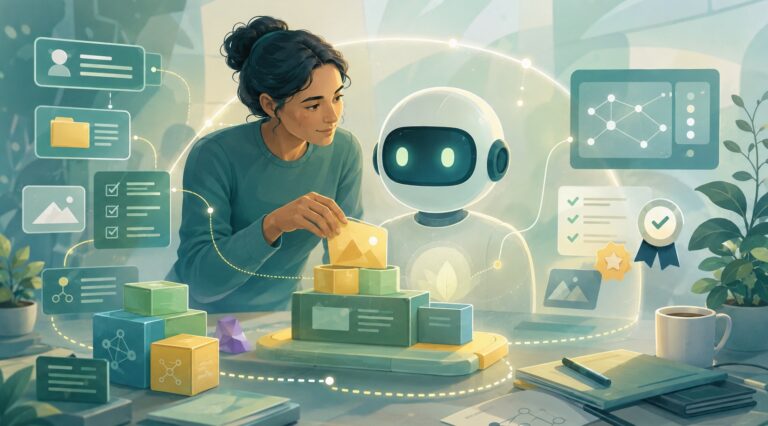
And sometimes the answer is a hybrid system, where the old and the new work together instead of competing for attention.
That feels like a more mature way to think about the future.
Learning has always known this
Learning and Development has a lot to teach the AI conversation here, because in education we already know that old does not automatically mean obsolete.
ADDIE did not disappear because it was developed decades ago. We still return to it because it gives us a useful structure for thinking about analysis, design, development, implementation, and evaluation.
We still talk about Piaget, Vygotsky, Skinner, Pavlov, Bloom, and many other authors whose work came long before generative AI, virtual reality, learning analytics, adaptive platforms, or agentic systems.
Why?
Because many of the questions they explored are still alive.
How do people learn? How do they build understanding? How does feedback shape behavior? How do we scaffold growth? How do we move from support to independence? How do we design experiences that help people think, not just complete tasks?
Technology changes quickly. Human learning does not change at the same speed.
That does not mean we should teach the same way forever. It does not mean traditional education was perfect. It does not mean we should ignore new media, new tools, or new learner behaviors.
But it does mean we should be careful when we throw away old frameworks just because they do not sound futuristic enough.
The old stuff often still works because it was built around human needs, not software trends.
The future needs translation, not replacement
Of course, we cannot simply copy old methods into a new world and expect them to work.
We are competing with technological distractions, fragmented attention, short-form media, overloaded calendars, constant notifications, and learners who are used to interactive, immediate, personalized experiences.
That applies to young students, university learners, and working adults. It applies to classrooms, onboarding programs, corporate training, professional development, and almost every space where people are expected to learn while life keeps moving around them.
So yes, we need to speak their language.
We need to design learning that feels relevant. We need to create experiences that resonate. We need to use media, storytelling, interactivity, AI, automation, and digital tools in ways that make learning more accessible, engaging, and useful.
But speaking the learner’s language does not mean surrendering to every trend.
It means translating strong learning principles into the environments where people actually live and work.
It means using new tools to support old truths, not pretending that every new tool replaces everything we already know.
That is the balance.
Use the old theory. Use the new tools. Do not confuse novelty with quality. Do not confuse automation with impact. Do not confuse an agent doing more with a human learning more.
The middle ground is where maturity lives
I think the next stage of AI maturity will not be about who has the most autonomous agents.
It will be about who can design the most appropriate systems.
Systems where rules handle what rules are good at. Automation handles what automation is good at. AI handles what AI is good at. And humans remain involved where judgment, ethics, context, taste, interpretation, and responsibility matter.
That may sound less exciting than a fully autonomous future, but it is probably much closer to what organizations actually need.
Because the goal is not to automate everything.
The goal is to make work better.
The goal is not to remove humans from the loop.
The goal is to place human judgment exactly where it creates the most value.
The goal is not to use the newest technology everywhere.
The goal is to design systems that are useful, sustainable, explainable, and safe.
That is why “lo viejo funciona” feels so relevant right now.
Not because the past was better. Not because the future is dangerous. But because some older ideas still protect us from very modern mistakes.
Clear boundaries still work. Decision trees still work. Checklists still work. Human escalation still works. Instructional design still works. Learning theory still works. Manual review still works. Common sense still works.
And AI works better when we stop asking it to replace all of those things.
Maybe the real future is not fully traditional or fully futuristic. Maybe the real future is hybrid.
A future where we know when to automate, when to generate, when to pause, when to review, when to simplify, and when to let the old stuff do what it has always done well.
Because sometimes, the most mature thing we can say about a process is not:
“Let’s make it agentic.”
Sometimes it is:
“Lo viejo funciona.“