What the panic around AI gets wrong about talent, creative work, and the future of human judgment
I started thinking about this after watching another conversation about AI and the future of Learning and Development. At first, it sounded like a very specific industry discussion. Another conference recap. Another reflection on how much AI is changing learning. Another warning that the old way of building courses, modules, slides, assessments, and training assets is starting to break.
But the more I listened, the more I realized that the conversation was not really about L&D. It was about every field where people have confused production with value.
You can see the same argument happening in film, design, writing, education, medicine, marketing, software, journalism, and probably every other profession where someone creates something for someone else.
Some people are excited because AI removes friction. Some people are angry because it feels like theft, replacement, dilution, or disrespect toward the craft. Many people are somewhere in the middle: using the tools because they are useful, while still feeling uneasy about what these tools may do to the work they care about.
I understand that fear.
When a tool can generate in seconds what used to take hours, days, or weeks, it is natural to feel the ground move. If you spent years learning a tool, mastering a workflow, or building your professional identity around a production process, watching AI produce a rough version of that work almost instantly can feel insulting. It can feel like the world is telling you that your craft was never that special.
But I think that reaction often points us toward the wrong conclusion. The real question is not whether AI can generate something. Of course it can. The better question is whether it can generate something with vision, taste, intention, and meaning.
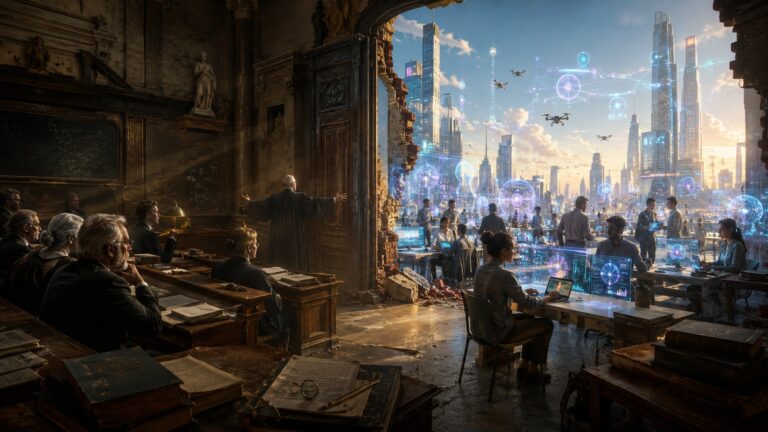
That is where the conversation changes. AI can mimic a lot of things. It can mimic format, tone, structure, genre, and surface-level style. It can generate something that looks like a course, a strategy, a script, a poster, a lesson, a slide deck, a brand concept, or a movie scene.
But the surface is not the work. The output is not the thinking. The artifact is not the vision.
The Exhaustion of the Container
This distinction matters a lot in L&D because, for a long time, our field has been trapped inside production bottlenecks.
A stakeholder asks for training. A recording gets uploaded. A deck becomes a module. A transcript becomes a summary. A quiz gets added at the end. The course goes live. Completion gets tracked. Everyone moves on.
There is nothing inherently wrong with producing learning materials. Courses, videos, decks, guides, assessments, and job aids still matter. But when the whole profession gets reduced to producing those objects, something important gets lost.
- We start treating the container as if it were the learning.
- We start measuring activity as if it were understanding.
- We start mistaking the ability to build something for the ability to know whether that thing should exist in the first place.
That is where AI becomes uncomfortable. Not because AI destroys the real work, but because it exposes how much of the work was never the real work to begin with.
If your entire value proposition is operating the old bottleneck, then yes, AI is going to feel threatening. If your role is built around turning weak PowerPoints into slightly more interactive weak modules, or spending forty hours fighting with triggers, variables, timelines, exports, layouts, and formatting, then the ground is going to shake.
But that was never the soul of instructional design. That was the tax we paid to get something built.
The deeper work was always somewhere else:
- Understanding the learner.
- Diagnosing the real problem.
- Asking whether training was even the right answer.
- Designing practice and creating useful friction.
- Structuring knowledge and building context.
- Supporting performance and helping people move from information to actual capability.
That kind of work is not disappearing. It is becoming more important. And the same shift is happening across the creative spectrum.
A great filmmaker is not great because they can technically put images on a screen. A great designer is not great because they can arrange objects inside a layout. A great writer is not great because they can produce grammatically correct sentences. A great learning designer is not great because they can build a module or upload content to a platform.
Those skills matter. But they are not the deepest source of value.
The deeper value is the ability to see what the work is trying to become before it exists. To sense what is missing, what is false, what is generic, what is emotionally empty, what is confusing, and what should be removed. It is the ability to understand a human problem and then shape an experience, story, system, or artifact around that problem.
That is direction. That is taste. That is vision.
Originating the Wound
This is why I keep thinking about someone like Guillermo del Toro when people talk about AI replacing creative work. AI can probably generate a gothic hallway. It can create a strange creature, a dark fairy-tale image, or something that looks vaguely like the surface of his visual world.
But Del Toro is not Del Toro because he can produce monsters. He is Del Toro because he has a specific, unrepeatable worldview. His work carries memory, tenderness, obsession, symbolism, pain, beauty, and a very human relationship with the strange and the wounded.
The monster is not the point. The monster is the language. AI can imitate the language. It cannot easily originate the wound.
That gap exists in every field.
In L&D, AI can draft a course outline, summarize a transcript, generate a first version of an assessment, organize raw material, produce examples, clean up a document, or create a rough storyboard. That is incredibly useful.
But none of that means the model understands the learner, the organization, the hidden politics behind the request, the pressure people are under, the cultural issue being disguised as a training problem, or the difference between a course that looks complete and a learning experience that actually helps someone improve.
That still requires human judgment. And maybe that is the part that makes people uncomfortable. AI is not only threatening because it can do things quickly. It is threatening because it reveals how much human work was already generic before AI entered the room.
Automated Weak Thinking
A lot of corporate content was already low-effort. A lot of training was already unfocused. A lot of decks were already unclear. A lot of strategies were already full of important-sounding language that said almost nothing. A lot of assessments were already checking whether someone clicked through the material, not whether they understood anything.
AI did not create that problem. It simply gave it a faster engine.
This is what I mean by human slop.
Human slop is the messy document nobody questioned. It is the training request that should have been a process conversation. It is the compliance module that exists only so someone can say people completed it. It is the slide deck with no real structure, no real narrative, and no real learner in mind. It is the course built from a PowerPoint that was already confusing. It is the meeting summary that becomes a document, then becomes a module, then becomes a quiz, while everyone politely pretends learning happened.
AI can mimic that very easily because there is not much there to protect. Generic work has no immune system. It has no center. It has no point of view.
If a person gives an AI tool vague instructions, messy context, half-formed ideas, and no clear standard of quality, the model will still generate something. It may even look polished. It may sound professional. It may be formatted nicely. It may survive a quick glance.
But underneath the polish, there is nothing there. That is not the rise of machine creativity. That is the automation of weak thinking.
And this is where people need to step up.
I do not mean that in a cruel way. I do not think people are disposable. I do not think everyone who feels anxious about AI is lazy, outdated, or lacking talent. A lot of the anxiety is valid, especially when companies use AI as an excuse to cut costs, flatten roles, ignore ethics, or automate work they never understood in the first place.
But the standard is rising.
AI raises the floor. It makes basic production easier, faster, and cheaper. More people will be able to generate something that looks acceptable. More teams will be able to produce drafts, summaries, images, videos, modules, documents, and prototypes without waiting weeks for production cycles.
That means the value has to move upward:
- From production to judgment.
- From tool operation to taste.
- From content creation to context engineering.
- From “I can build this” to “I understand whether this should be built, why it matters, who it serves, and how it should work.”
That is not a downgrade. That is a return to the real work.
Beyond the Slide Deck
In L&D, this means we should stop defending the bottlenecks as if they were sacred. Spending hours fighting with authoring tools was never the soul of instructional design. If AI can reduce that cost, good. Let it.
Then use that saved time for better needs analysis, deeper learner research, better accessibility, better practice design, stronger feedback loops, better knowledge architecture, and better integration into the real workflow.
The opportunity is not to generate more courses faster. That may be useful sometimes, but it is not the transformation. The real opportunity is to build better learning ecosystems. Cleaner knowledge structures. More useful support inside the flow of work. Better ways for people to ask questions, test understanding, reflect, practice, and apply knowledge when they actually need it.
This is why I keep coming back to AI Nutrition.
The quality of AI output depends heavily on the quality of what we feed it. A model working with messy, outdated, biased, or disconnected information will generate confident noise. A model working inside a curated, intentional, well-structured knowledge environment can become genuinely useful.
But someone still has to build that environment. Someone has to decide what matters and what should be excluded. Someone has to know which source is current, which explanation is clear, which example is useful, which risk needs a boundary, and where the human must remain in control.
That someone is not just a tool operator. That someone is a designer. A teacher. A strategist. A creative thinker.
The Higher Stakes
This is also why I find the broad “AI is bad” argument too simple.
There are valid criticisms of AI. Real concerns about training data, copyright, labor, consent, bias, energy use, misinformation, privacy, and the way companies rush to automate without understanding the consequences. Those concerns should not be dismissed. We need better regulation, better governance, better transparency, better boundaries, and much more maturity around these tools.
But rejecting the technology entirely, as if it only exists to make fake movie posters, cheap videos, or soulless corporate content, misses the larger picture. This shifting standard is not only about art or slide decks. The stakes are higher when we look at how this technology is being used in science and medicine.
AI is becoming a critical pillar of biology, drug discovery, diagnostics, and public health. Computational protein design and AI-based structure prediction have helped solve molecular problems that challenged scientists for decades. Medical devices increasingly include AI-enabled features. Vaccine development now uses computational models alongside traditional experimental validation.
So no, I do not want a world where we delay scientific progress because we flattened the conversation into “AI bad”. I do not want to wait longer for a diagnostic tool, a treatment, or a research breakthrough because we decided that computational support somehow makes the work less human.
Doctors should still be doctors. Scientists should still be scientists. Teachers should still be teachers. Artists should still be artists. But I absolutely want them to have better tools.
The problem is not AI helping professionals move faster through the bottlenecks. The problem is lazy delegation.
There is a massive difference between using AI to expand your thinking and using AI to avoid thinking.
- One turns the tool into leverage; the other turns it into a slop machine.
- One asks better questions; the other accepts the first answer.
- One uses AI as a collaborator under human direction; the other treats AI like a vending machine for finished work.
That difference will define the next few years.
The Premium on Taste
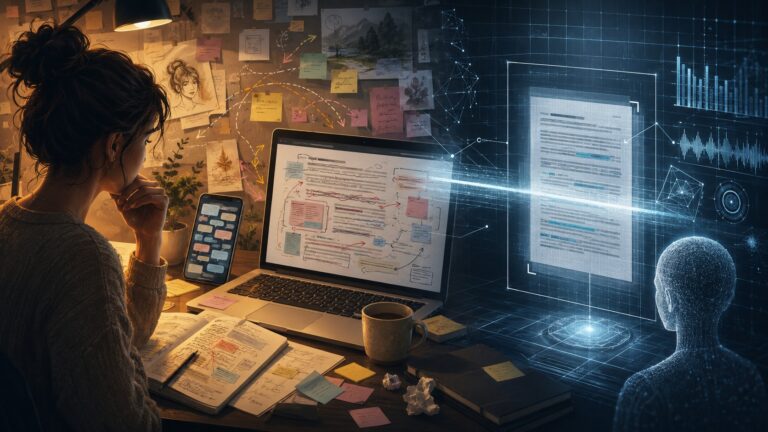
For people with vision, AI can become a time expander. It can compress the repetitive parts of the process so there is more room for analysis, experimentation, reflection, and craft. It can help a writer explore structures, a designer compare directions, a teacher create practice examples, a learning designer prototype scenarios, a researcher organize literature, or a strategist map possibilities.
But the person still needs to know what they are doing. The person still needs standards.
This is where taste becomes one of the most important professional skills of the AI era.
Taste is the ability to look at an output and know it is not good enough. Taste is being able to say, “This is polished, but empty.” Taste is knowing when something is too generic, too predictable, too obvious, too safe, or too disconnected from the real human problem. Taste is what prevents us from confusing fluency with intelligence and speed with quality.
- Vision is what comes before the output.
- Taste is what judges the output after it appears.
- Judgment is what connects both to a real human need.
That combination is incredibly hard to replace.
This is why I do not think the future belongs to people who simply know how to prompt. Prompting matters, but prompting without vision is just a faster way to request mediocrity. The future belongs to people who can frame problems, curate context, challenge assumptions, protect meaning, and use AI without surrendering responsibility to it.
In creative work, we need to stop pretending that all outputs are equal just because they look finished. A generated image is not the same as a film. A generated paragraph is not the same as an essay. A generated course is not the same as a learning experience.
The artifact matters. But the thinking behind the artifact matters more.
AI can mimic slop because slop is shallow. It can mimic the generic because the generic has already been repeated thousands of times. It can mimic average because average is everywhere. It can mimic work that never had a strong point of view in the first place.
But work that comes from vision, talent, taste, care, and lived human experience is harder to flatten. Not impossible to imitate on the surface, but very hard to replace at the source.
That does not mean talented people can relax. It means the opposite. People need to become better thinkers, better curators, better critics, better designers, better teachers, and better users of the tools we now have.
The age of hiding behind production is ending.
The age of hiding behind “I know the software” is ending.
The age of hiding behind slow execution as proof of quality is ending.
What remains is the harder question: What do you actually bring to the table?
- If the answer is vision, AI gives you leverage.
- If the answer is taste, AI gives you options.
- If the answer is judgment, AI gives you speed.
- If the answer is curiosity, AI gives you range.
- If the answer is discipline, AI gives you scale.
But if the answer is only “I can operate the bottleneck”, then yes, this moment will hurt.
That does not mean humans are obsolete. It means the standard is rising.
And maybe that is exactly what we needed.