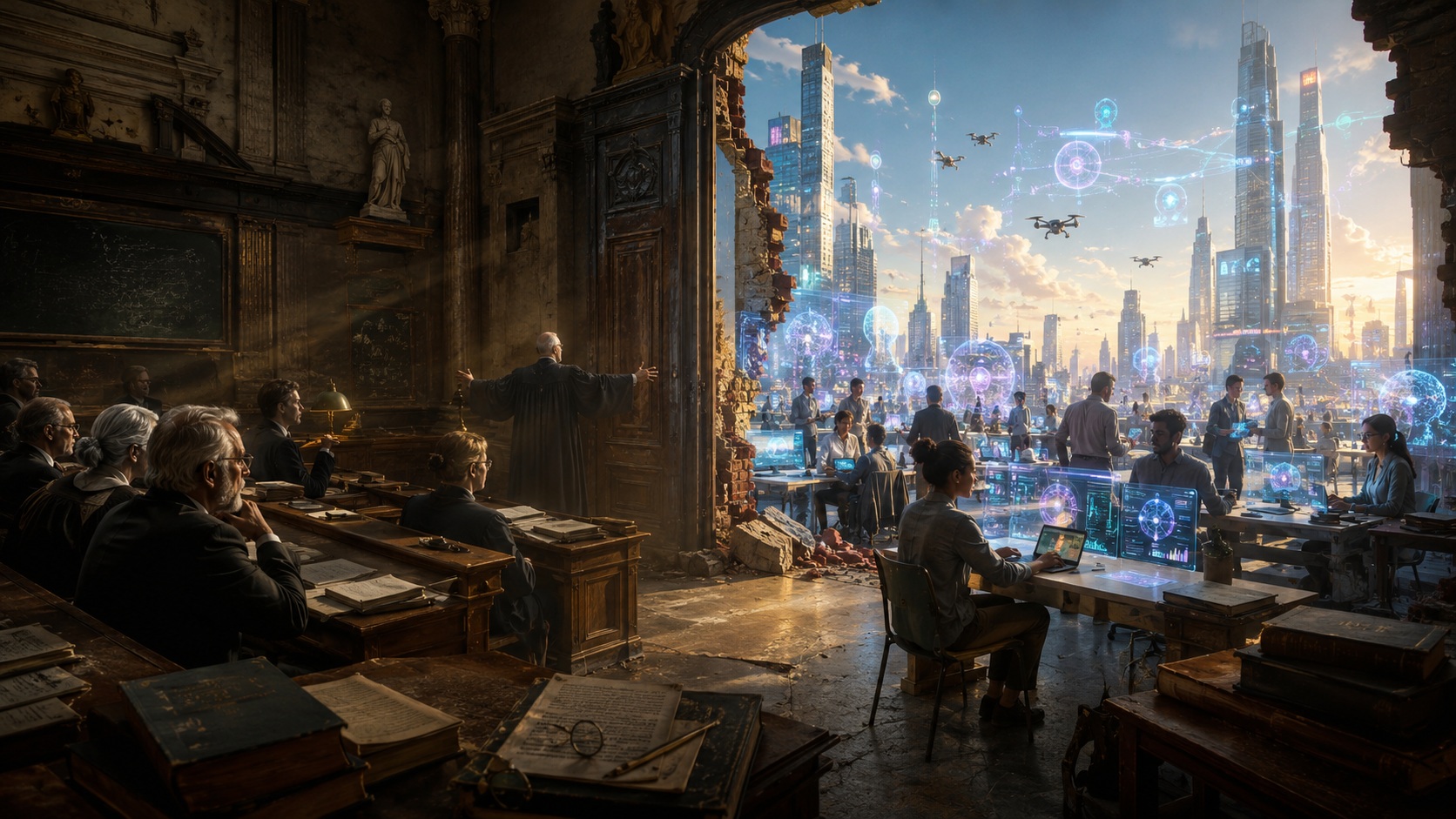
George Orwell wrote something in Notes on Nationalism that I keep coming back to:
One has to belong to the intelligentsia to believe things like that: no ordinary man could be such a fool.
It is a cruel line. It is also a useful one.
Because there are ideas so disconnected from ordinary life that only very educated people can defend them with complete seriousness. There are institutional positions so removed from work, tools, deadlines, clients, audiences, and consequences that they can only survive inside rooms protected from the results of believing them.
I think about that every time I see a school or university try to ban AI.
Not teach it carefully.
Not regulate it intelligently.
Not build assignments around its limits, dangers, and possibilities.
Ban it.
Outside the classroom, the debate has already moved. People are using AI. Lawyers are using it. Recruiters are using it. Developers are using it. Designers, writers, marketers, analysts, managers, and administrators are using it. The person writing the email you receive tomorrow morning has probably used it somewhere in the process.
For most workers, this is no longer a philosophical crisis.
It is Tuesday.
And yet somehow, in the place where students are supposedly being prepared for work, banning one of the defining tools of that work can still sound like a serious response.
No ordinary worker could be such a fool.
It was never about age
That sounds harsh. I know. But the reason it feels so frustrating is that I already wrote the softer version of this argument in 2023. I was studying digital technology for education, and I tried to be polite about what I was seeing. I wrote about respecting experience. I wrote about modernization. I wrote about openness. I made the case with the hopeful patience of someone who still believed the problem was mostly a lack of integration.
And part of that was true.
Experience matters. I do not want to pretend otherwise. Some of the best teachers I have ever had were older, sharper, and more alive to the world than people half their age. A good teacher with decades of experience can see patterns the rest of us miss. They can tell when a student is confused before the student can name the confusion. They can separate a serious idea from a fashionable one.
That kind of experience is not obsolete.
It is rare.
So the problem is not age. The problem is not tradition. The problem is not even academia as a whole.
The problem is distance.
Distance from the profession. Distance from the tools. Distance from the workflows students will actually meet. Distance from the ordinary reality of how work is now being done.
The problem starts when confidence outruns contact.
It starts when people who haven’t hired anyone, shipped anything, or worked outside the institution in fifteen years sit in a committee and decide that AI, a tool their graduates will be expected to understand almost immediately, is not appropriate for the classroom.
You have to admire the confidence.
But you do not get to veto a tool you have not tried to understand.
That is where the contradiction becomes difficult to ignore. A classroom does not need to worship every new technology. It should not. Education has a responsibility to slow things down, to ask better questions, to notice what the market rewards but the human being may not need. The classroom should be one of the few places where we can say: wait, what is this tool doing to our attention, our writing, our judgment, our learning?
But that criticism has to come from knowledge.
A serious critique of AI is necessary. A lazy rejection of AI is not serious critique. It is just fear with institutional authority.
There is a difference between saying, “This tool can damage learning if used too early”, and saying, “This tool has no place here”.
There is a difference between designing limits and preserving ignorance.
That is why blanket bans worry me. They do not teach judgment. They teach concealment. Students do not stop using the tool because a policy tells them not to. They learn to use it quietly, badly, and without guidance. The institution keeps the appearance of control, while the real learning moves underground.
Forbid the tool, trust the scanner
And then, in one of the strangest turns, the same institutions that distrust AI enough to ban it often trust AI detectors enough to punish students with them.
These scanners cannot see a draft. They cannot see a process. They cannot see a person. They cannot see the student who revised carefully, the student who reads heavily, or the student writing in a second language who sounds formal because formality became a survival strategy.
They see fluency and call it suspicious.
So we forbid the useful tool and deputize a worse one to hunt for it.
That is not technological literacy. That is technological panic.
Currency is contact
But AI detectors, bad policies, and awkward PowerPoints are only the visible symptoms. The deeper problem is older than AI.
A lot of people teaching a profession are no longer in contact with that profession. Some never built a deep contact with it in the first place. They studied the field, entered the institution, and stayed there while the field moved on outside the window.
This is uncomfortable to say because teaching is noble work. I believe that. I teach, officially and unofficially, and I know how much care it takes to help someone understand something they could not see before. Teaching is not a lesser version of doing. At its best, it is one of the most demanding forms of doing.
But teaching a profession requires contact with the profession.
Not necessarily a job title. Not necessarily a perfect résumé. Not necessarily having spent twenty years inside the industry. Some people who work in a field have nothing to teach. Some people outside it remain excellent guides because they never stop paying attention.
That is the distinction that matters.
Currency is not a job title.
Currency is contact.
Contact with the work. Contact with the tools. Contact with the people doing the job now. Contact with the pressures, expectations, compromises, and standards students will meet after graduation.
A teacher with that contact can prepare students even without a traditional industry background. A teacher without it can only describe the world they remember.
The arts panic loudest
This is especially visible in the arts, where the contradiction becomes almost theatrical. Fields that speak constantly about creativity, experimentation, disruption, image, form, language, and culture can become strangely conservative the moment a new tool appears. The same spaces that celebrate rupture in theory can panic when rupture arrives as software.
But art has never been untouched by tools.
The camera changed painting. Digital editing changed film. Synthesizers changed music. Desktop publishing changed design. Remote collaboration changed production. Every major change in the tools of making has forced artists and educators to ask what should be preserved, what should be rejected, and what should be learned.
AI is not outside that history.
It is simply the newest and loudest version of it.
A ban is not a policy
And yes, AI can produce slop. It can flatten taste. It can help students avoid the exact friction that would have taught them something. It can create the illusion of competence before competence exists. I do not dismiss that danger. In fact, that is where the real educational work begins.
That is the whole point of the Zone of No Development: there are moments when AI can help, moments when it should stop, and moments when using it too early removes the very struggle the student needed in order to grow.
That is a serious conversation.
A ban is not.
A good AI policy should ask: what skill are we trying to develop here? Where does the tool support that skill? Where does it replace it? When should the student use AI as a collaborator, and when should they sit with the blank page long enough to build the muscle themselves?
Those are educational questions.
They require teachers to learn the tool well enough to know when it helps and when it harms. They require assignments where process matters, where students explain choices, compare outputs, defend revisions, and show how judgment shaped the final work. They require us to move beyond pretending that a finished document tells the whole story.
That is difficult.
It is much easier to ban the tool and call the ban integrity.
But the cost of that laziness does not fall on the committee.
It falls on the student.
We ban students from practicing with one of the most consequential tools of their working life, grade them on pretending it does not exist, and then send them into a market where fluency with that tool is becoming part of the baseline.
The language may be academic integrity.
The outcome is practical disadvantage.
Students do not graduate into the world imagined by the policy. They graduate into the world that already exists.
Lo viejo funciona
That is what my 2023 self was trying to say more gently. Education does not have to discard everything old. It should not. Some old things work because they are old in the best sense: tested, human, durable.
Lo viejo funciona.
The old book works. The old conversation works. The old teacher who can look at a student and understand what they are not yet able to say works. The old discipline of rewriting a sentence until it finally carries the thought works. The old demand that students think before they produce works.
But the part worth preserving was never the ritual itself.
It was the responsibility underneath it.
The responsibility to stay close to the world students are being prepared to enter. The responsibility to update the map when the territory changes. The responsibility to admit that a classroom cannot become a museum and still call itself preparation.
Because the most dangerous thing a classroom can do is confuse control with education.
And that, I think, is what Orwell’s line still catches so well. Some beliefs only survive inside rooms protected from the consequences of believing them.
So the question is not whether academia should surrender to every new tool.
The question is whether it can remain serious while refusing to understand the tools that already shape the lives of the people it claims to prepare.