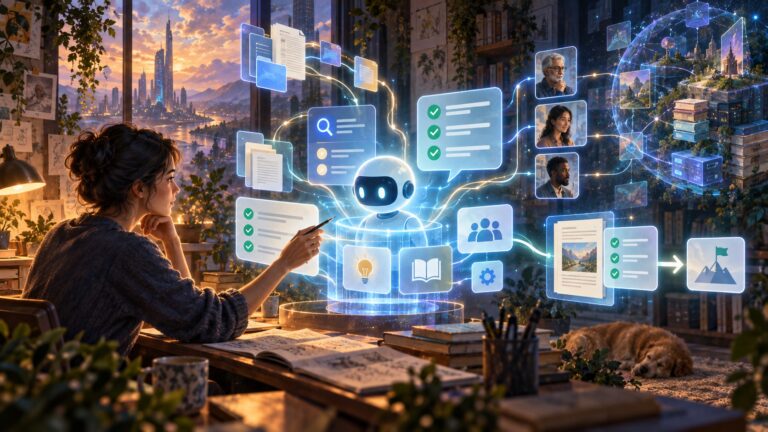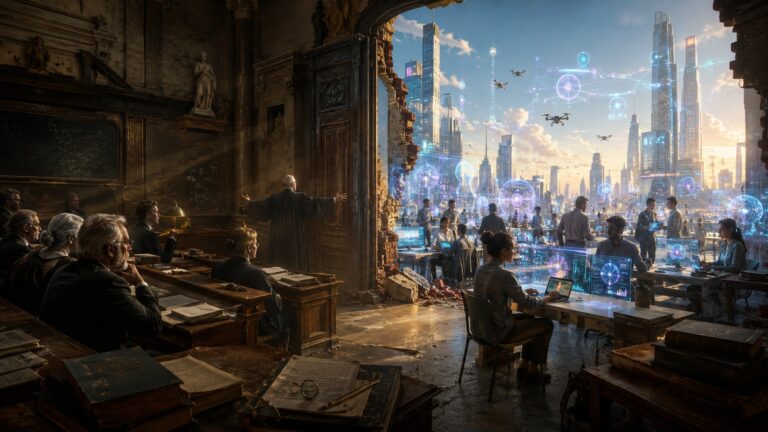
The thumb became a prompt, but the responsibility is still human.
Michel Serres used Thumbelina as a metaphor for a new kind of human being shaped by the digital revolution: someone who communicated with her thumbs, moved naturally through screens, learned outside traditional institutions, and lived in a world where information was no longer scarce, distant, or locked away.
I always liked that image. The young person with a phone in her hands. The student who no longer waited for the teacher to be the only source of knowledge. The learner who searched, connected, messaged, watched, remixed, and navigated a much larger world through a small device in her pocket.
But the world changed again.
The screen did not disappear. The phone did not become irrelevant. The thumb still scrolls, taps, writes, reacts, searches, and plays. But in the age of generative AI, something new has entered the scene. The screen no longer only gives us access to information. It answers back.
It drafts, summarizes, explains, translates, classifies, recommends, simulates, and sometimes invents. It does not simply open the door to knowledge. It produces something that looks like knowledge right in front of us.
That shift deserves a new metaphor.
Maybe Thumbelina has become Promptbelina.
Not because the old metaphor was wrong. It still matters. But it now feels incomplete. Thumbelina belonged to the age of the touchscreen, the search engine, the social platform, and the always-connected learner. Promptbelina belongs to the age of the prompt box, where the most powerful interface is no longer only the screen we touch, but the conversation we start with a machine.
The bridge generation meets the prompt box
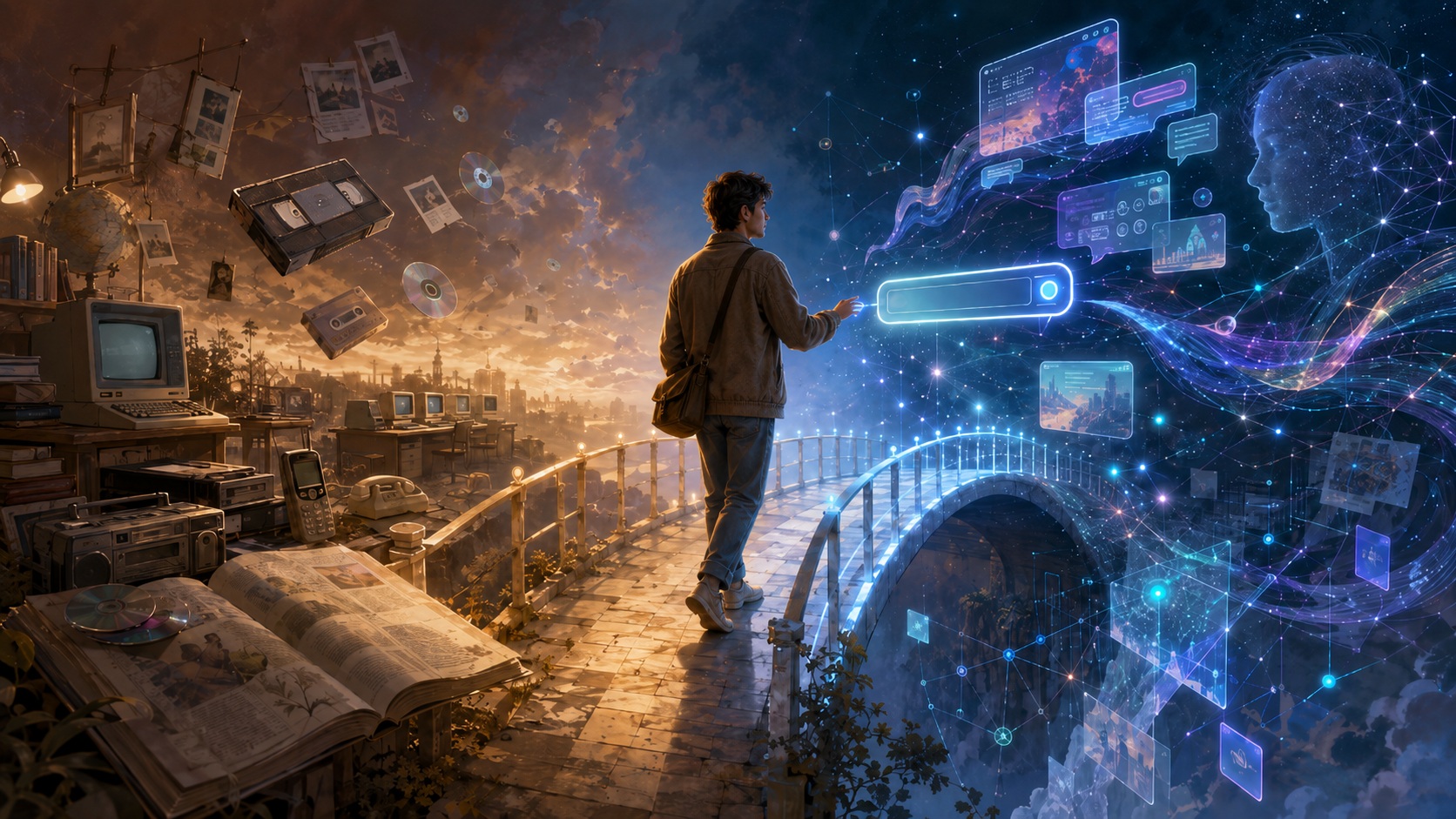
There is another idea I keep returning to when I think about Thumbelina in 2026: the idea of Digital Bridges.
For a long time, conversations about technology were dominated by two categories: Digital Immigrants and Digital Natives. One group had to adapt to digital technology later in life. The other supposedly grew up speaking its language naturally. I always found those categories useful, but incomplete. They explain part of the story, but they leave out those of us who were born during the transition itself.
Those of us born in the late eighties did not arrive in a fully digital world, but we also did not experience technology as something completely foreign. We grew up in the middle of the shift. We saw music move from cassettes and CDs to MP3s and streaming. We saw movies move from VHS to DVD and then to platforms. We saw phones move from fixed lines to mobile devices and then to small computers we carry everywhere. We saw dial-up become broadband. We saw computer labs become personal laptops. We saw printed encyclopedias become search engines.
We were not simply born into the digital world. We crossed into it.
That is why I like the idea of Digital Bridges. It describes a generation that learned to translate. We translated technology for parents, teachers, grandparents, colleagues, and institutions. We explained remote controls, email attachments, file formats, online forms, passwords, privacy settings, search engines, cloud storage, and eventually learning platforms. We became interpreters between people who saw technology as disruption and people who saw it as normal.
But in the age of AI, that bridge role is changing again.
The challenge is no longer only helping someone use a device, open a platform, upload a file, or search for information. The challenge now is helping people understand what happens when the system no longer only stores, connects, or retrieves information, but starts producing answers on our behalf.
That is a different kind of transition. The first bridge connected the analog world with the digital world. The new bridge connects the digital world with the AI-mediated world. And this is where Promptbelina appears.
Thumbelina was the child of the touchscreen. Promptbelina is the person standing in front of the prompt box, learning how to ask, verify, doubt, refine, and take responsibility for what comes back.
For Digital Bridges, this feels familiar and unfamiliar at the same time. Familiar, because we have already lived through a technological transformation that changed how people communicate, learn, work, and build identity. Unfamiliar, because AI does not simply change the tool. It changes the relationship between the person and the production of thought.
When search engines arrived, we had to learn how to find information. When social media arrived, we had to learn how to participate in networks. When smartphones arrived, we had to learn how to live with permanent connection. Now, with generative AI, we have to learn how to collaborate with systems that can produce language, explanations, images, summaries, arguments, plans, and decisions.
That is why the role of Digital Bridges matters again. We are not here only to teach people how to use AI. That would be too small. We are here to help translate what AI changes, what it does not change, and what should never be delegated completely.
Because the real bridge is not between humans and machines. The real bridge is between speed and judgment, between automation and responsibility, between access and understanding, between using AI and thinking with AI.
From access to generation
The first digital revolution was mostly about access. Search engines gave us access to information. Social media gave us access to people. Smartphones gave us access to almost everything, everywhere, all the time.
That alone was enough to challenge traditional education. If knowledge was no longer trapped inside textbooks, classrooms, libraries, or experts, then teaching could not remain the same. The teacher could no longer be imagined only as the person who delivers information. The classroom could no longer be understood only as the place where information is received. The learner could no longer be treated as someone waiting passively for knowledge to arrive from above.
But AI changes the relationship again, because AI is not only about access.
AI is about generation.
A search engine offers possible sources. An AI system offers an answer. That difference matters because an answer feels finished. It arrives already shaped, already organized, already fluent. It can sound confident even when it is wrong. It can look thoughtful even when it is shallow. It can make weak ideas feel polished and copied thinking feel original.
This may be one of the biggest cultural shifts of the AI age. We are no longer only surrounded by information. We are surrounded by fluency.
And fluency is seductive.
A clean summary can hide missing context. A beautiful explanation can remove the friction that learning sometimes needs. A polished draft can make us feel closer to mastery than we really are. A chatbot can turn confusion into something that looks organized, but organization is not the same as understanding.
This is where the conversation around AI literacy needs to become more serious. It is not enough to teach people how to write better prompts, just as it was never enough to teach people how to click the right buttons. A prompt can be useful, but a prompt is not a substitute for thinking. A polished response can be helpful, but a polished response is not the same as knowledge.
That is why Promptbelina needs more than digital skills.
She needs judgment.
The prompt is not the thought
There is a lazy way to talk about AI that says people are no longer thinking because machines can answer for them. I do not think that is completely fair.
Humans have always used tools to extend their minds. Writing extended memory. Books extended knowledge. Calculators extended computation. Search engines extended access. Maps extended orientation. Spreadsheets extended analysis. Slides extended communication. Learning platforms extended classrooms.
AI belongs to that long history of human beings creating tools that reshape what they can do.
The problem is not that people use tools to think. The problem begins when people stop noticing which part of the thinking they are giving away.
That is the real challenge of Promptbelina. When I ask AI to summarize something, am I saving time after doing the reading, or am I avoiding the reading completely? When I ask AI to generate ideas, am I expanding my perspective, or am I replacing my curiosity? When I ask AI to rewrite my text, am I improving clarity, or am I slowly losing my own voice? When I ask AI to explain a concept, am I learning, or am I just collecting a smoother version of my confusion?
These questions matter because AI does not only automate tasks. It can also automate parts of the cognitive journey.
And learning is not only about reaching the answer. Learning is also about the path toward the answer: the false starts, the doubts, the comparisons, the mistakes, the effort to explain something in your own words, and the uncomfortable moment when you realize you do not understand something as well as you thought.
That friction is not a bug in learning. Very often, it is the learning.
This is also why the Digital Bridge role becomes more demanding in the age of AI. In the early digital era, we often helped people understand how technology worked. In the AI era, we also need to help people understand what technology is doing to their habits of thought.
The danger is not only that someone uses the wrong tool. The danger is that they use the right tool in a way that weakens their own ability to question, connect, interpret, and decide.
Education cannot pretend this is not happening
This is where Serres still feels relevant.
The educational system has always been slow to adapt to cultural and technological change. That does not mean every old practice is useless. In fact, some older practices matter more than ever: reading carefully, discussing ideas, writing with intention, checking sources, asking better questions, listening to others, and building arguments step by step.
The old stuff works when it still serves a human purpose.
But education cannot pretend AI does not exist. It cannot solve the AI problem by banning tools that students already use outside the classroom. It cannot rely only on detection systems that confuse probability with proof. It cannot keep designing assignments where the final answer matters more than the process. It cannot treat every use of AI as cheating while also preparing learners for a world where AI will be part of work, research, communication, and creative production.
The question is no longer simply: “Did the student use AI?”
The better question is whether the student can explain, verify, challenge, improve, and own what AI produced.
That is a very different educational standard, because it moves the focus from output to judgment. It asks us to care less about whether a paragraph looks finished and more about whether the learner understands what the paragraph means, where it came from, what it leaves out, and whether they can stand behind it.
This does not mean lowering standards. It means updating them.
In many cases, the real evidence of learning will not be the final answer alone, but the learner’s ability to show how they worked with the answer. What did they ask? What did they verify? What did they reject? What did they improve? What did they understand differently after using the tool?
In the age of Promptbelina, a good learner is not the person who refuses every tool. A good learner is also not the person who accepts every answer. A good learner is someone who can work with powerful tools without disappearing into them.
The global village became synthetic
Serres wrote in a world where digital tools were turning the planet into a global village. That idea still matters, but it now feels incomplete.
The internet connected people across distance. It allowed us to communicate with anyone, anywhere, anytime. It blurred geographical, cultural, and social boundaries. It made the world feel closer, faster, and more interconnected.
AI adds another layer to that village. The village is no longer only global. It is also synthetic.
Some voices are human. Some are AI-generated. Some are human ideas polished by AI. Some are machine outputs edited by humans. Some are automated. Some are fake. Some are useful. Some are persuasive nonsense. Some are technically correct but ethically empty.
That means the new literacy is not only digital literacy. It is not enough to know how to use a platform, search online, create content, or participate in a network.
We also need epistemic literacy: the ability to understand how knowledge is produced, how claims are supported, how sources are evaluated, how uncertainty works, how bias appears, how systems can fail, and how confidence can be manufactured.
In simpler terms, we need to know when to trust, when to doubt, when to verify, and when to stop.
That may be one of the most important skills of 2026. Not prompt engineering as a trick. Not AI fluency as a buzzword. Judgment. The ability to look at a convincing answer and ask whether it is true, whether it is complete, whether it is useful, whether it is ethical, whether it is mine, and whether I understand it enough to stand behind it.
This is also where Digital Bridges can make an important contribution. We know what it feels like when a technology becomes normal before institutions know how to respond. We know what it feels like when tools move faster than policies, classrooms, workplaces, and habits. We have seen people overestimate technology, fear it, misunderstand it, resist it, and eventually depend on it.
That experience matters now, because AI is producing the same confusion at a much higher speed.
Promptbelina is not just a generation
It is tempting to describe Promptbelina as the next version of the digital native. Thumbelina belonged to the smartphone age, while Promptbelina belongs to the AI age. That reading works, but I think it is still too narrow.
Promptbelina is not only a generation. Promptbelina is a condition.
A teenager using AI for schoolwork is Promptbelina. A teacher redesigning assignments because old assessments no longer work is Promptbelina. A manager asking AI to summarize employee feedback is Promptbelina. A designer using AI to prototype learning experiences is Promptbelina. A researcher using AI to explore patterns in interviews is Promptbelina. A writer asking AI for feedback while trying to preserve their own voice is Promptbelina.
We are all entering the prompt box now, but we do not all enter it in the same way. Some people enter with curiosity. Some enter with fear. Some enter with laziness. Some enter with discipline. Some enter because work demands it. Some enter because learning feels easier there. Some enter because the world is moving too fast and AI feels like a way to keep up.
The important question is not only whether we use AI. The important question is what happens to our attention, voice, memory, curiosity, and judgment while we use it.
That question matters especially for those of us who once acted as Digital Bridges. We already helped one generation cross into the digital world, and we helped another understand that being born around technology does not automatically mean using it wisely. Now we need to do something similar with AI.
We need to help people see that using AI is not the same as understanding AI, and that getting an answer is not the same as developing a point of view.
The responsibility is still human
I like the metaphor of Promptbelina because it keeps something playful inside a serious conversation. It reminds us that every technological age creates a new image of the human being. The printing press changed memory and authority. The school changed childhood and citizenship. The internet changed access and identity. The smartphone changed attention and presence. AI is changing language, work, creativity, and learning.
But none of these tools remove the human responsibility to think. They only change where that responsibility appears.
In the age of AI, responsibility appears in the prompt. It appears in the context we provide, the data we choose not to paste, the sources we check, the questions we ask, and the moment we decide not to use an answer just because it sounds good. It appears when we slow down enough to notice that speed is not the same as understanding.
That may be the real lesson of Promptbelina.
The future of learning is not about choosing between humans and machines. It is about learning how to stay human while thinking with machines.
Serres helped us see that a new kind of person had emerged from the digital revolution: connected, mobile, collaborative, fast, and shaped by the thumb. The idea of Digital Bridges helped me understand that some of us were not simply natives or immigrants, but translators between worlds. In 2026, those two ideas meet inside the prompt box.
The thumb became a prompt. The screen became a conversation. The search became an answer. The learner became a collaborator with systems that can help, distort, accelerate, confuse, and amplify thought.
But the responsibility is still human.
Because Promptbelina can ask the machine almost anything.
The real question is whether she still knows how to ask herself what matters.